Chemical Manufacturing: Controlling Material Consumption and Batch Costing in Assembly Production
A fertilizer maker replaced manual BOM math with assembly orders, stock alerts and automated bookkeeping, cutting errors and unifying operations with finance.
The Costing Pressure Behind Complex Chemical Formulas
Chemical producers face a familiar triad of headaches: recipes with many precisely balanced inputs, inventory that must be tracked to the exact unit, and costs that are painful to calculate correctly. When production is organized order by order, any weakness in material planning ripples straight into late deliveries, tied-up cash and distorted margins. The path forward is fine-grained digital control that connects the shop floor to the ledger.
Company Snapshot
This case covers a Shanghai-area chemical manufacturer that produces fertilizer products, including blended fertilizer, nitrogen fertilizer, urea and ammonium sulfate. It builds to order: a sales order triggers raw-material purchasing and product assembly, so accurate material planning and trustworthy costing are central to the whole business. Seasonal demand swings also meant the planner had to scale inputs up and down quickly without losing control of stock. Before the upgrade, those planning and costing capabilities were the company's weakest link.
Three Pressing Challenges
Raw-material demand had to be worked out by hand
On receiving a sales order, planners checked the product's bill of materials against current stock and calculated purchase quantities manually. Because formulas mix many inputs in exact ratios, every order meant re-checking each material for sufficiency and then deciding how much to buy. The work was slow, and mistakes were costly: under-buying stalled production, while over-buying locked cash in idle inventory.
Inventory lacked any early-warning system
Although a physical count happened monthly, there was no real-time low-stock alert. Shortages surfaced only mid-production, forcing emergency purchases that threatened delivery dates. At the same time, no one was watching slow-moving stock, so excess material quietly absorbed working capital and warehouse space.
Operations and finance lived in separate worlds
Purchase, sales and inventory records were kept apart from the accounting books. After operations staff entered a document, the finance team re-keyed the same information to post a voucher. That double entry was heavy labor and a steady source of mismatches, undermining both the accuracy and the timeliness of financial reporting.
How the ERP Resolved It
Assembly orders auto-calculate what to buy
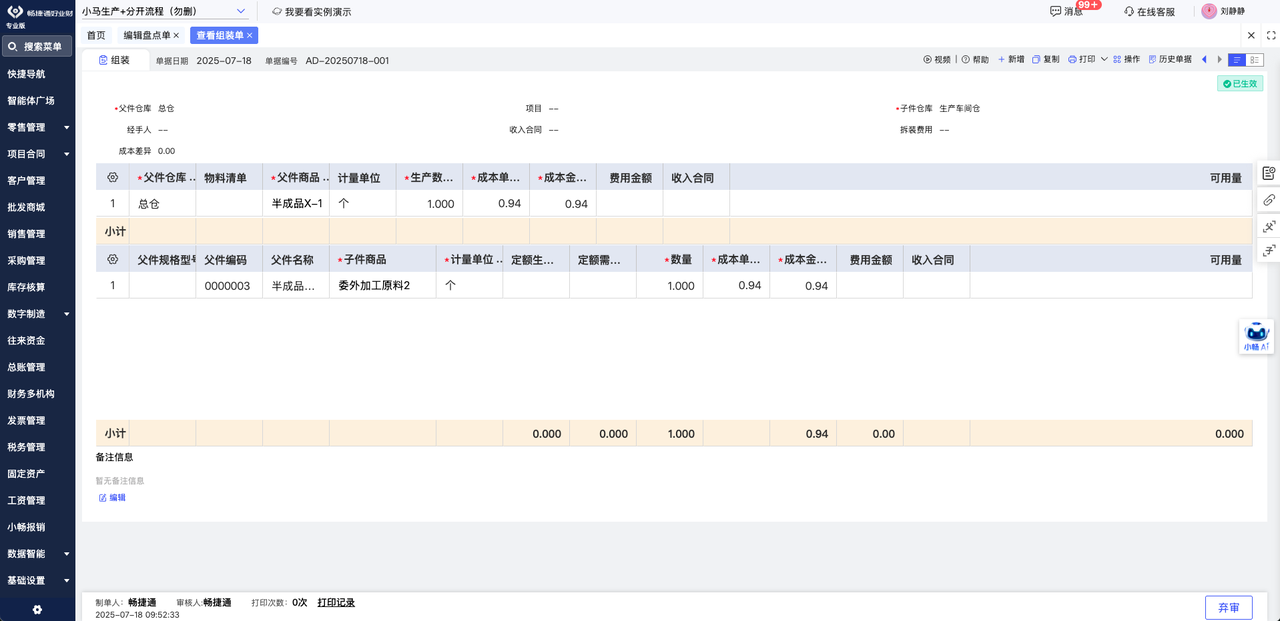
Standard bills of materials were built in the system, spelling out exactly which inputs and ratios each finished good requires. Entering a sales order now generates an assembly order automatically, computing the precise material quantities needed without manual arithmetic. When the assembly order is approved, the system deducts inputs from stock by BOM ratio and adds the finished goods, while raw-material cost is collected into the product automatically, giving accurate per-unit costing.
Live inventory monitoring with smart alerts
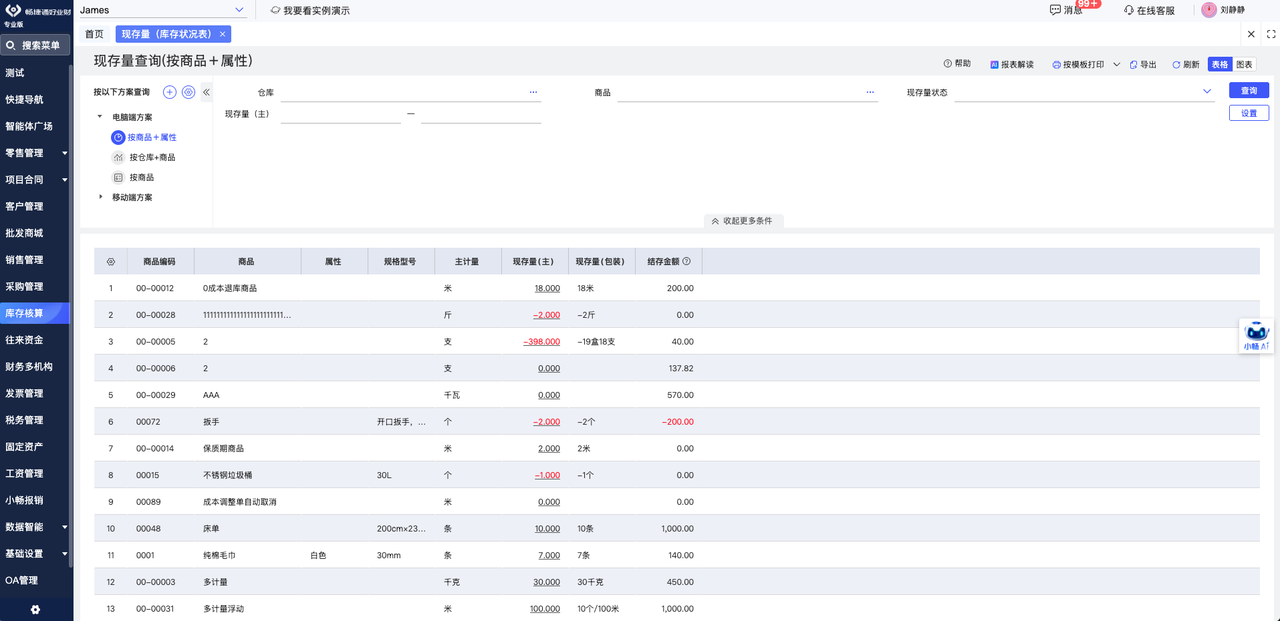
A stock-on-hand query lets planners view inventory by product, warehouse and other dimensions in real time, with filters that surface items that are low or overstocked. A shortage-alert function warns automatically when a material drops below its safety level, so buying can be scheduled before production breaks. The system also computes available quantity on the fly, blending current stock, goods in transit and already-allocated amounts into a reliable number for planning.
One system for operations and finance
Posting became automatic. Approving a purchase receipt creates the corresponding voucher covering material receipt and accounts payable; approving a sales dispatch generates revenue and inventory-out vouchers, so the books stay in step with the floor. Inventory auxiliary accounting tracks both quantity and value of raw materials and finished goods, while receivable and payable auxiliary accounting follows each customer and supplier, enabling granular control of working-capital relationships.
Measurable Outcomes
Assembly orders and shortage alerts let the firm calculate material needs from the sales order and plan purchasing against true available stock, removing manual errors and avoiding both stockouts and overbuying. That lifted cash turnover and trimmed carrying cost. Real-time, multi-warehouse visibility meant shortages were caught early and replenished in time, protecting production continuity and keeping records matched to physical stock.
Unifying operations with finance erased the duplicate data entry entirely. With vouchers created straight from business documents, the accounting team could shift its energy to analysis and decision support, and the accuracy and speed of reporting improved across the board.
Takeaway
Beyond fixing material calculation, inventory control and finance alignment, the ERP gave this manufacturer a precise, efficient and integrated production platform. In a commodity business where margin lives in the details, that integration is what turns cost discipline into a durable competitive edge.
Related reading
Solving Apparel Wholesale Pain Points with Online Selection and Smart Warehousing
An apparel wholesaler cut order-entry time, reduced churn, and tamed multi-warehouse picking with a cloud ERP. Online selection and attribute cataloging streamlined the flow.
Read guide →Customer Case StudyAustralia Frozen Meat Processor: Accurate Costing for Whole-Chicken Cutting
How a Melbourne frozen-meat processor used ERP barcode, BOM disassembly and batch control to cut receiving time and cost every chicken part precisely.
Read guide →Customer Case StudyHow a Beijing IC Company Achieved Finance–Operations Integration for Precision Management
A Beijing integrated-circuit maker unified purchasing, outsourcing, kit sales, and accounting in one ERP, automating cost allocation and cutting month-end close effort.
Read guide →