Solar PV Installer Controls Construction and Operating Cost per Project
A solar-PV installer managed construction-phase and operating-phase costs and profits per project through income contracts, purchase and subcontract agreements in one system.
Company Profile / Background
A solar-photovoltaic installation company designs, builds, and operates PV arrays for customers ranging from factories to commercial rooftops. What makes this business unusual is that every engagement has two distinct lives. The construction phase consumes panels, inverters, mounting hardware, and skilled labor, while the operating phase is where the asset earns revenue through power generation and incurs upkeep such as cleaning, monitoring, and component replacement. A blended company profit figure hides the truth: one rooftop installation may be highly profitable while another quietly loses money. The business needed to see the cost and profit of each individual project across both phases, not just an aggregate number.
Core Challenges
Construction-phase cost invisible per project
During build-out, purchased materials, labor subcontracting and various expenses touched each site, but none of it was cleanly attributed to the project. Management could not see whether a particular installation was on budget as work proceeded.
Two phases, one unclear profit picture
Construction spend and later operating cost belonged to the same physical project, yet they were tracked separately. Without a per-project link, the true lifetime profitability of an array stayed unclear, and the owner could not tell whether a low construction bid was later erased by expensive maintenance.
How the System Solved It
The company adopted a project-based ERP approach in which every customer job becomes a single project record that carries both its build and its operation. Using the HaoYeCai cloud ERP suite (the ERP product by Chanjet), the team set up each engagement this way from day one.
Project set up by customer
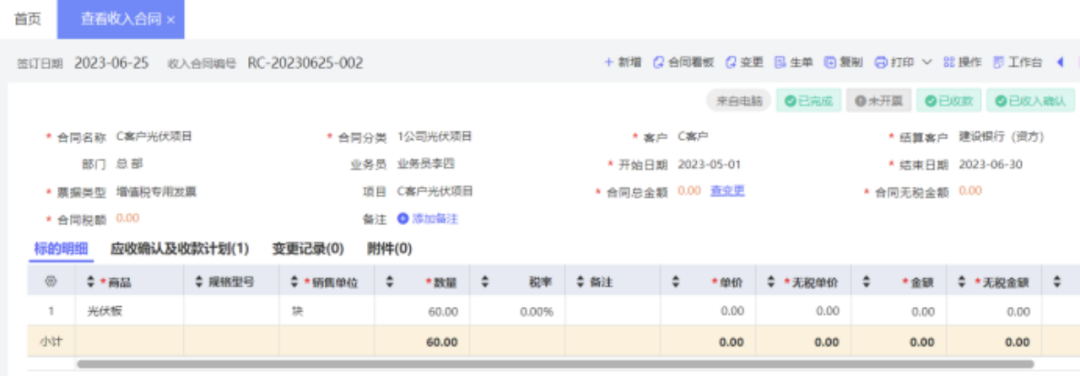
The platform creates a project for each customer engagement. Within it, the team opens an income contract with an amount of zero, because the build itself is an internal cost project rather than a sale to the end customer. This zero-value income contract acts as the anchor that every downstream purchase, subcontract, and expense attaches to, so nothing in the build escapes the project's cost roll-up.
Procurement and subcontract tied to the contract
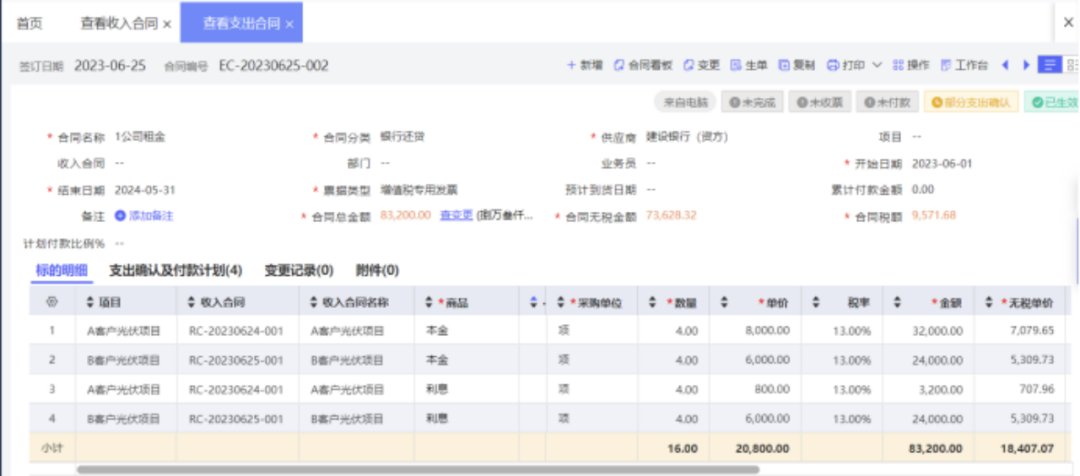
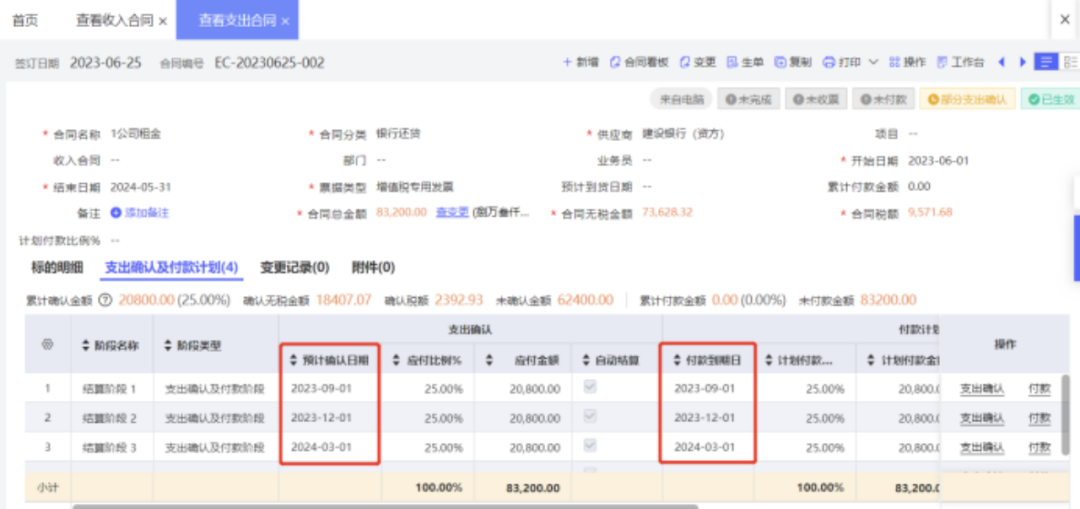
All materials procured, labor subcontracted and expenses incurred for the project are recorded against that income contract as purchase contracts, subcontract agreements and expense payments. Because the entries are linked from the start, the system rolls them up into the project's construction-phase cost automatically, with no manual tally at month end and no lost receipts.
Operating-phase cost tracked on the same project
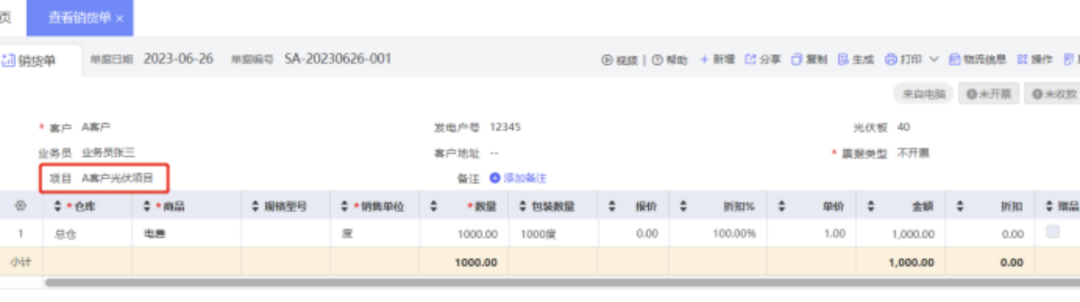
Because the same project record spans both lives of the asset, operating-phase costs such as monitoring fees, cleaning, and parts replacement are posted to the same card. The project's profit can then be monitored across the full construction-to-operation view, so a single dashboard shows whether the array is paying back as expected.

Measurable Results
Clear build-phase cost per site
Linking every purchase, subcontract and expense to the project's income contract means construction-phase cost is visible per array as it is incurred. Budget drift is caught during the build rather than at settlement, and the owner can step in to renegotiate a subcontract or pause spend before losses mount.
Lifetime profit by project
With construction and operating costs on one project record, the installer can judge the true profitability of each PV installation and compare sites, portfolios and contract structures with confidence. That comparison turns quoting from guesswork into a repeatable, evidence-based process.
Better Bids and Lower Risk
With a reliable per-project history, the installer can price new jobs from real build and maintenance data instead of rules of thumb. Low-margin contract structures are flagged before signing, and the finance team can model how a change in panel cost or labor rate flows through to profit. Over time this discipline protects both cash flow and reputation.
Conclusion
Solar-PV work is really two businesses, building and operating, under one roof. By managing each engagement as a single project with an income contract anchor, the ERP suite gives the installer per-project cost and profit across both phases without spreadsheet surgery. The result is faster, better-informed bidding and a clear line of sight from the first panel to the final maintenance call. For a business where one bad bid can echo through years of maintenance, that clarity is what turns a project shop into a predictable operation.
Related reading
Solving Apparel Wholesale Pain Points with Online Selection and Smart Warehousing
An apparel wholesaler cut order-entry time, reduced churn, and tamed multi-warehouse picking with a cloud ERP. Online selection and attribute cataloging streamlined the flow.
Read guide →Customer Case StudyAustralia Frozen Meat Processor: Accurate Costing for Whole-Chicken Cutting
How a Melbourne frozen-meat processor used ERP barcode, BOM disassembly and batch control to cut receiving time and cost every chicken part precisely.
Read guide →Customer Case StudyHow a Beijing IC Company Achieved Finance–Operations Integration for Precision Management
A Beijing integrated-circuit maker unified purchasing, outsourcing, kit sales, and accounting in one ERP, automating cost allocation and cutting month-end close effort.
Read guide →